Too Much Inventory Taking Up Valuable Space & Tying Up Cash?
When inventory starts piling up, it takes up more than space. It ties up cash, limits flexibility, and makes it harder to see what is actually being consumed.
What this Looks Like
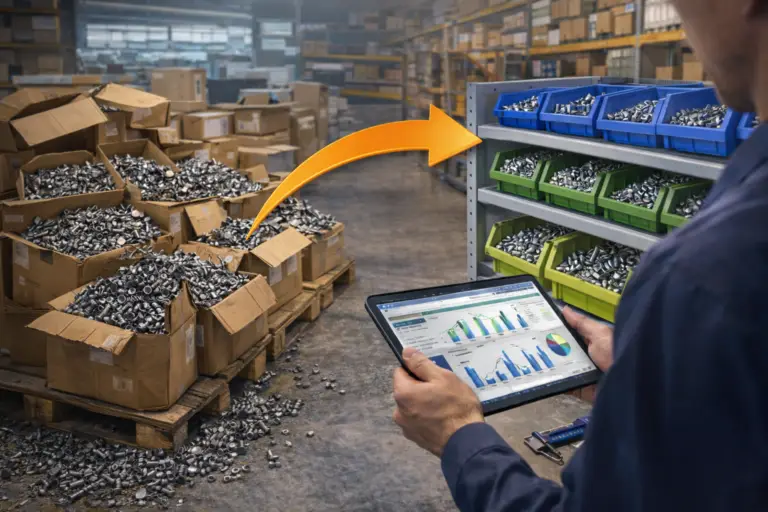
Inventory levels creep up over time. Orders are placed to avoid shortages, safety stock gets padded, and before long there is more material on the shelf than anyone originally planned for.
Racks are full, overflow starts to take up additional space, and it becomes harder to quickly identify what is needed versus what has been sitting for months.
At that point, inventory is no longer just supporting production. Rather, it is taking up space, time, and attention.
What Excess Inventory Is Really Costing You
Carrying more inventory than necessary has a direct impact on working capital. Money that could be used elsewhere in the business is tied up in material that is not moving.
It also adds operational friction. More inventory means more to manage, more to count, and more to sort through. It increases the likelihood of obsolescence, especially when designs change or demand shifts.
Improving inventory turns is not just a metric. It is a reflection of how efficiently inventory is moving through your operation instead of sitting on a shelf.
Best Practice for Inventory Management
Inventory levels are aligned with actual usage, not worst-case assumptions. Material flows in and out at a steady pace, and space is used intentionally rather than reactively.
Teams spend less time managing excess and more time focused on production. Cash is not unnecessarily tied up, and inventory turns improve because material is moving consistently.
The goal is not to carry less inventory at the expense of risk. It is to carry the right amount so production stays supported without overloading the system.
We're Here to Improve Inventory Efficiency
At Specialty Bolt & Screw, we work with OEMs to better align inventory with actual demand and usage patterns. That includes:
- Establishing inventory levels based on real consumption
- Implementing replenishment strategies that reduce over-ordering
- Supporting more consistent inventory flow across locations
- Helping improve inventory turns without increasing stockout risk
The focus is on creating balance. Inventory should support production without becoming a burden on space or capital.
Are You Experiencing Other Production Challenges?
 Español de México
  English